A simple derivative
In math, a 'function' specifies
how to transform one value into another, corresponding one. For instance, the function
f(x) = x2 says to square every value of x: 2 becomes 4; 3 becomes 9; -4
becomes 16, etc.
The derivative of a function specifies the
slope of that function at any value of x. For instance, the derivative of f(x) = x2 is
f'(x) = 2x. Hence, the slope of f(x) = x2 at x = 4 equals
2x = 8, whereas at x = 3, the slope equals 2x = 6.
The Wikipedia page on derivatives has a nice
simulation of this:
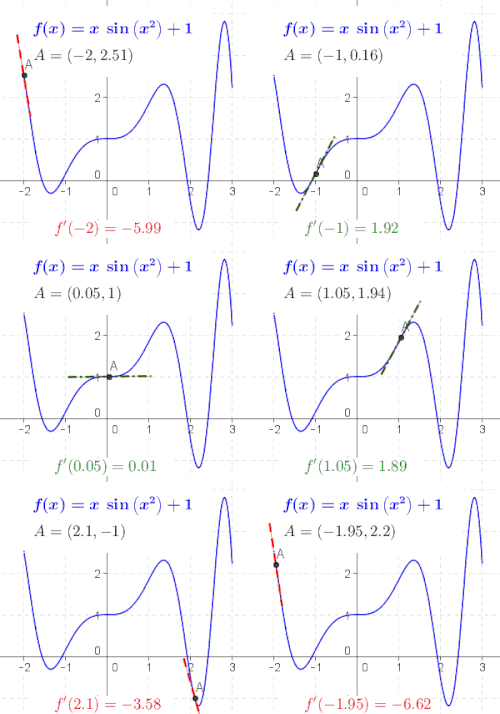 Notice how the derivative — the dashed line— 'grazes' the graph of the
function f(x) at each point, but has a different slope at each point because the graph of
the function f(x) has a different slope at each point.
Below, three functions are plotted for values of x (-10 ≤ x ≤ +10):
Notice how the derivative — the dashed line— 'grazes' the graph of the
function f(x) at each point, but has a different slope at each point because the graph of
the function f(x) has a different slope at each point.
Below, three functions are plotted for values of x (-10 ≤ x ≤ +10):
- f(x) = x2 (blue curve)
- The derivative for f(x) = x2; here f'(x) = 2x (green curve)
- The tangent for f(x) = x2 at x = 4 (red curve)
Below, you can play with this. You select the exponent n for the function
f(x) = xn and a value for x that specifies where to plot the tangent to
f(x) = xn, and the browser will plot the corresponding three functions.
|